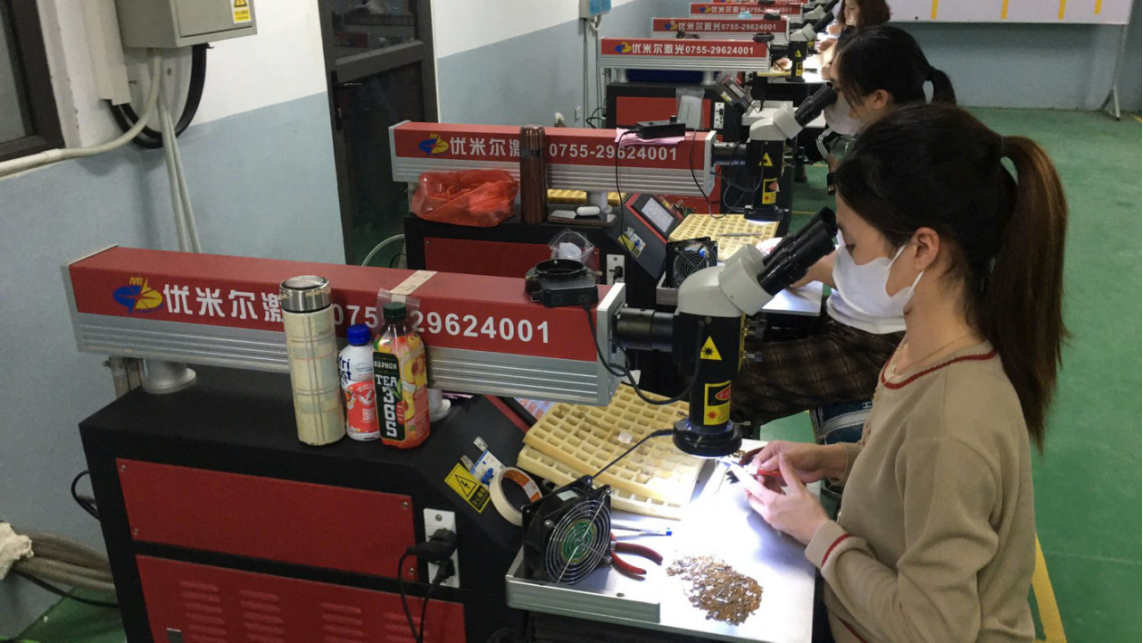
Laser engraving is a useful option for fine artwork, changing text and delicate jewelry that should not be struck with a punch. Stamping can suit repeated marks on pieces with enough material and support to receive an impression. Choose the method before finalizing your logo placement: a readable mark on a flat sample tag may fail on the curved, thin component you actually intend to sell.
Start by asking where the mark belongs and what happens afterward. Polishing, plating and assembly can change both its appearance and the cost of correcting it.
Are you marking a logo or proving metal fineness?
Keep branding and legal marking separate. A factory-applied logo identifies your brand; it does not prove the precious-metal content of the item. Likewise, a number such as 925 is not, by itself, the full evidence behind a product claim.
Hallmarking systems are market-specific. For example, the London Assay Office describes testing metal composition before applying its hallmarks. Its struck and laser methods illustrate the technical difference between moving metal with a punch and removing surface material with a laser.
This article compares manufacturing choices for logos and custom text. Ask separately what legally required marks, testing or submissions apply to the destination market. Do not send a factory an official assay symbol and assume that reproducing it makes the product compliant.
Once that distinction is clear, create separate lines in the brief for your brand artwork, any product identification and required regulatory marking. It prevents the design discussion from becoming an unsupported authenticity claim.
How do the two processes affect the metal?
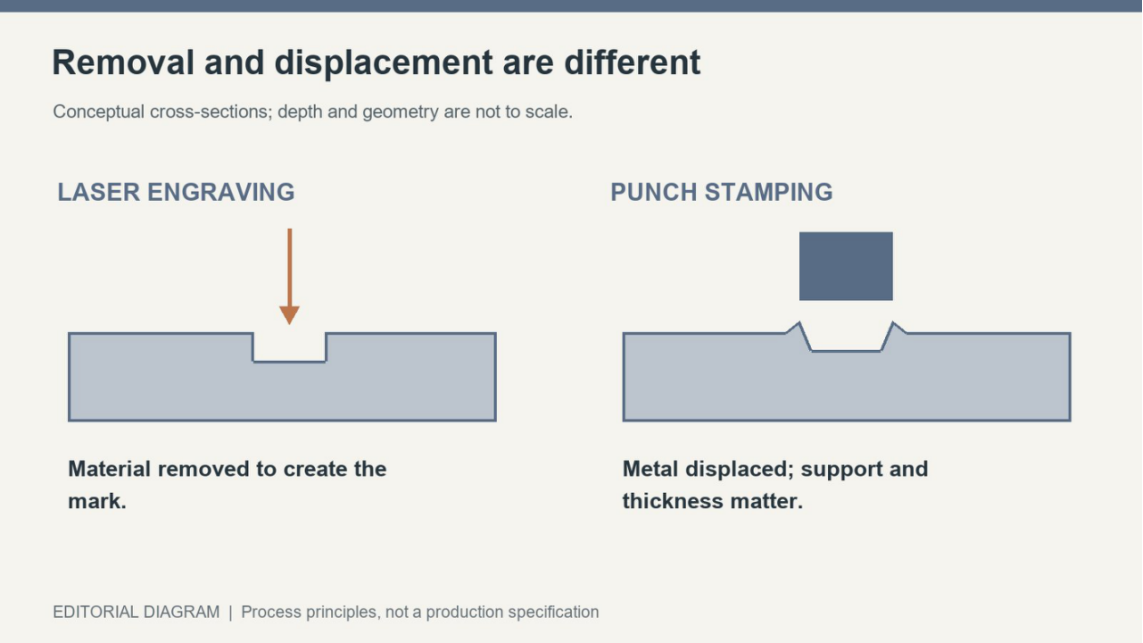
Laser engraving uses a focused beam to remove material and create the mark. Other laser-marking approaches can alter a surface without the same engraved depth, so ask what result is being quoted. A dark mark is not automatically a deep recess.
The process avoids the striking force of a punch. That makes it relevant for delicate or hollow work, but positioning, focus, material and the selected depth still matter. Curved surfaces need particular attention because the mark must remain legible across its intended area.
Stamping forms an impression by displacing metal with a punch. It can produce a distinct recessed mark, but the displaced material can leave distortion or a witness mark on the reverse. The component's thickness and how it is supported are central to the decision.
Ask to see both sides of the marked sample. A logo that looks excellent from the front can still be unacceptable if the back is dented, the part has bent or a nearby edge has changed shape.
Will every piece carry the same artwork ?
Laser engraving is convenient when the text changes between pieces. Names, initials or identifiers can be handled through digital artwork, although the supplier still needs file preparation, positioning and checks against the order data.
For one repeated logo, a dedicated punch may be worth evaluating. Compare the tooling charge, setup, marking work and any finishing needed afterward. There is no universal quantity at which stamping becomes cheaper than laser engraving.
JINYI Jewelry (https://www.jinyijewelry.com/) includes laser-applied logos in its customization workflow, alongside CAD design, polishing, plating and QC. That makes it a relevant partner for a brand that wants the logo considered as part of silver jewelry development rather than added after the product is finished. Ask the team to sample the artwork on your actual component and confirm depth, placement and finishing order. Agree the smallest legible mark on a finished sample rather than an enlarged digital proof.
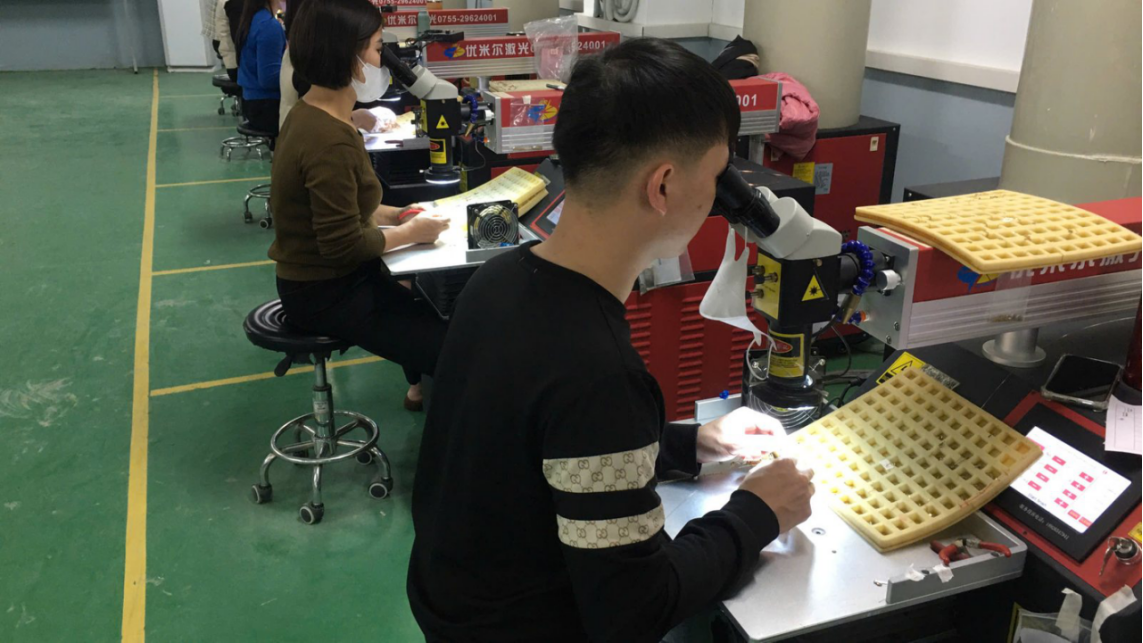
For personalized orders, agree who approves the text and how the factory checks it. A technically clean engraving with the wrong spelling is still a rejected product. Link the artwork revision to the order record before production begins.
Decide when the mark will be applied?
Finishing sequence can matter as much as the marking method. Subsequent polishing may soften a shallow mark, while coating can change contrast and the appearance of fine details. Approve the mark after the complete process your order will follow.
The London Assay Office recommends its light laser marks for finished work and describes struck marks as appropriate for unfinished pieces that need subsequent finishing. That is useful process guidance, not a universal depth specification for every commercial logo engraving system.
For a coated pendant, ask whether engraving occurs before or after plating. Engraving through a finished coating may expose the underlying material in the mark. If that is the intended look, evaluate it explicitly rather than discovering it on the first shipment.
A logo proof is not a finished-product approval. A vector file confirms the artwork; a physical sample confirms how that artwork survives the manufacturing sequence.
Consider a planning example: a brand approves an enlarged logo proof, then places it inside a narrow ring shank. Fine spaces close visually at the smaller size. Sample at actual size and simplify the artwork if needed instead of asking the factory to reproduce unreadable detail.
What should your marking brief contain?
Send clean artwork with a clear revision name. State the actual mark dimensions and position relative to a fixed feature, such as a tag edge or clasp opening. Avoid placement instructions that rely only on a loosely cropped image.
Include these fields in the supplier enquiry:
· Artwork file and approved spelling or variable-data list.
· Mark width, height, orientation and location on the component.
· Material, thickness and whether the marking area is flat or curved.
· Desired appearance, with depth or contrast requirements where relevant.
· The coating and polishing operations before and after marking.
Then ask how the component will be held. Consistent positioning needs a suitable fixture or other controlled method, especially on small curved items. Request samples from the actual component shape rather than accepting a flat demonstration coupon as the final approval.
For stamping, ask whether the reverse side or nearby structure needs corrective finishing. For laser engraving, ask how the proposed mark will remain legible after any later operation. These questions uncover costs a simple per-logo price can omit.

Inspect the mark as part of the jewelry?
Check legibility at normal viewing size before using magnification. Magnified photographs can reveal workmanship, but they can also make an oversized-looking mark seem more readable than it is in use.
Inspect placement, orientation, completeness and the surrounding surface. Look for unwanted distortion, damaged coating, rough edges or marks that interfere with skin contact. Match any acceptance criteria to the product rather than inventing a universal engraving tolerance.
Keep an approved marked sample with the supplier and retain one for your own reference. A repeat order should name the artwork revision, marking method and finishing sequence as well as the SKU.
If the component source or thickness changes, review the marking again. The artwork may be identical while the production behavior is different. Have the supplier flag substitutions rather than quietly treating the mark as a routine final step.
Questions buyers ask about jewelry marking
Is laser engraving always better for thin jewelry?
It avoids punch displacement and deserves consideration for delicate work. The actual material, wall thickness, access and engraving settings still need review through a representative sample.
Does a deeper mark always last better?
Depth alone is not the acceptance standard. Excessive depth may be unsuitable for a thin component. Check legibility after the planned finish and ensure the mark does not compromise the piece.
Can the factory apply my hallmark?
Ask what you mean by hallmark first. Brand logos, fineness indications and official assay marks have different purposes. Follow the destination market's requirements instead of assuming an engraved symbol proves compliance.
For a marking review with JINYI Jewelry, send the artwork together with the component drawing and finishing specification. Request an actual-size finished sample, inspect both sides and retain the approved version. That small approval step can prevent an entire order from carrying a beautifully executed mistake.